Your SF Office Needs to Beat Working From Home — Here's What 2026's Best Offices Are Doing
Your SF office needs to beat working from home. Here's what phygital design means, what the best Bay Area offices are doing in 2026, and the Section 179 tax angle on office renovations.
Here's the new challenge for San Francisco business owners who lease office space: your office has to be better than your employees' homes.
Not nicer necessarily. Better. More collaborative, more energizing, more worth the commute. Because in 2026, nobody is driving to an office just to sit on Zoom calls they could take from their couch.
The good news is that the most forward-thinking companies in the Bay Area have figured this out. The even better news — there's a tax angle to smart office investment that most business owners miss.
What "Phygital" Actually Means
Phygital is one of those buzzwords that sounds complicated but describes something pretty simple: blending the physical and digital into one seamless experience.
In an office context, it means the space itself responds to how people work. Sensors adjust lighting and temperature automatically. Meeting rooms detect how many people are in them and reconfigure accordingly. A remote employee joining a call has the same visual presence as someone sitting at the table. The technology is invisible — it just works.
ACTIU's 2026 office trends report describes it well: the phygital approach "connects the physical and the digital to enhance people's overall experience without creating barriers." The goal isn't to look high-tech. The goal is to remove friction so people can actually do their best work.

Why This Matters in San Francisco Specifically
SF's office market is recovering, but it's deeply bifurcated. Buildings that have invested in this kind of experience are sitting at around 7% vacancy. Commodity office space is above 40%. The gap between "destination office" and "empty building" has never been wider.
Iris Reads' SF office market analysis notes that SF leasing hit a six-year high in 2025, driven largely by AI companies. Brex and Coinbase — both of which had abandoned SF during the pandemic — signed new leases to return. The recovery is real, but it's selective. Companies are coming back to spaces worth coming back to.
Gensler's 2026 workplace trends put it plainly: if 2025 was the year of hybrid harmony, 2026 is the year offices stop playing it safe. The spaces winning talent and retention right now are designed as destinations — not obligations.
What the Best Offices Are Actually Doing
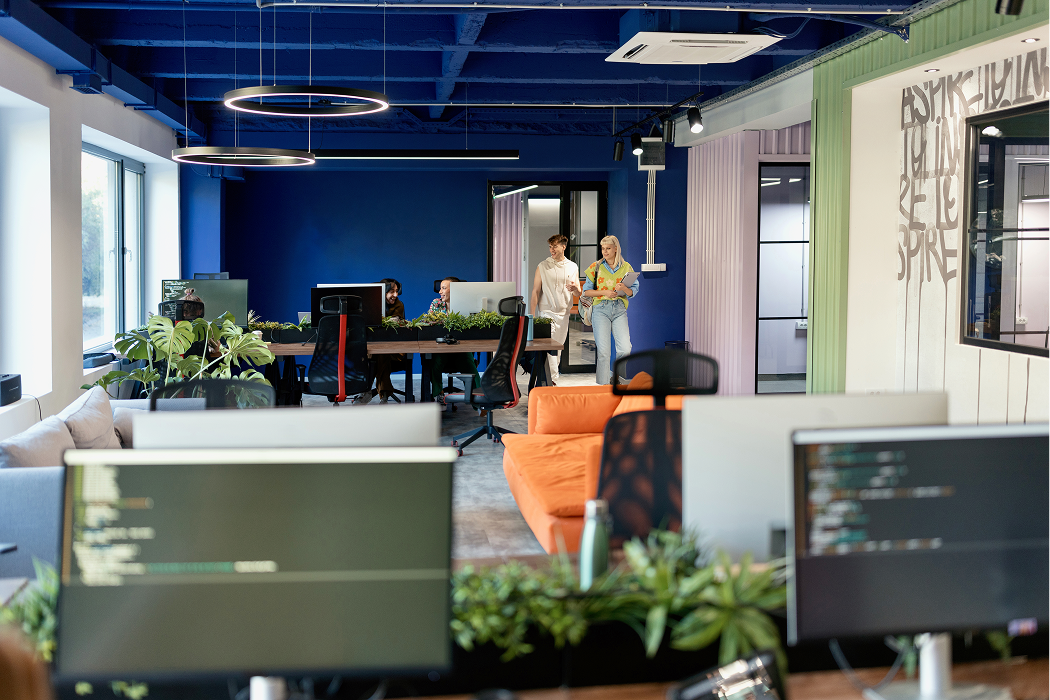
A few things that show up consistently in 2026's best-designed Bay Area offices:
Zones for different kinds of work. Not just open floor plan versus conference rooms. Actual sensory mapping — high-energy collaboration zones, quiet focus areas with acoustic control, and informal "collision" spaces in between where people bump into each other naturally. Limobel's 2026 office design analysis calls this the "regenerative workspace" — designed to give back more than it takes.
Meeting equity technology. In a hybrid office, the biggest problem is that in-person and remote participants don't have equal experiences. The best offices in 2026 use camera systems, spatial audio, and AI transcription to make everyone feel present regardless of where they are. UC Today's hybrid office technology overview covers what this looks like in practice.
Hospitality-inspired design. The sterile corporate office is dead. What's replacing it looks more like a boutique hotel lobby — welcoming, warm, specific. Comfortable furniture, natural materials, a café area worth lingering in. RI Workplace's 2026 design guide notes that companies borrowing from hospitality design see employees choosing to come in — not being told to.
Smaller, smarter footprints. Commercial Property Executive's 2026 office outlook found that companies are moving away from large centralized headquarters toward intentional, tech-enabled spaces. Less square footage, but every square foot matters. This is relevant for Bay Area business owners evaluating whether to renew, downsize, or redesign.
The Tax Angle Most SF Business Owners Miss
Here's where this becomes directly relevant to your bottom line.
Office improvements and renovations have real tax implications, and the right accounting approach can significantly reduce the after-tax cost of a redesign. A few things worth knowing:
Section 179 expensing allows businesses to immediately deduct the full cost of qualifying property — including office furniture, equipment, and certain improvements — in the year it's placed in service, rather than depreciating it over years. For 2026, the Section 179 limit is $1.22 million. A full office redesign with new furniture, AV equipment, and technology infrastructure could generate a substantial immediate deduction.
Qualified Improvement Property (QIP) — improvements to the interior of a nonresidential building — qualifies for 15-year depreciation and bonus depreciation treatment. If you own your building or make improvements under a lease, this is worth a conversation with your CPA before you sign any contracts.
Lease incentives and tenant improvement allowances from your landlord have their own tax treatment that many tenants handle incorrectly. How these are structured affects both your income and your depreciation schedule.
We've written about Q4 tax strategies for Bay Area business owners and small changes businesses can make in 2026 to increase profits. Office investment strategy fits right into both.
The Bottom Line
If your SF office feels like a place people come to because they have to — that's a talent and culture problem that has real business costs. The good news is that solving it doesn't necessarily require a massive budget. Thoughtful zoning, better acoustics, a real café setup, and technology that makes hybrid meetings not terrible can transform the experience without tearing down walls.
And if you're going to make that investment, do it in a way that maximizes your tax deduction.
At Asnani CPA, we work with Bay Area business owners on tax planning and bookkeeping that connects business decisions to real financial outcomes. We serve clients across San Francisco, San Jose, Palo Alto, Mountain View, and throughout the Bay Area.